
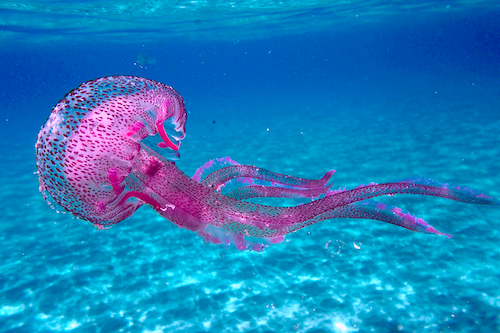
(Mauve stinger. Photo: internet)
Feeling the silky smooth water of the Aegean Sea against your skin. Rolling in the salty water that carries you amidst its waves. Swimming, straining your muscles, relaxing, floating, it’s one of the most delightful things to do in summer.
No wonder fish and other sea creatures seem to be so happy. Dolphins, for example, have a funny grin on their lips. I have encountered them several times in the water, which always brought a smile to my face. Fortunately, I have never seen a grumpy-looking shark cutting through the waves. Forever traumatized by the movie Jaws, I never go far out into the sea. Even though the last time a swimmer had a fatal encounter with a great white shark in Greece (in the Gulf of Volos, Thessaly) was in the mid-60s. Sharks, like the white one, are now regularly spotted in Greece, but that’s because so many people have become photo-trigger-dangerous these days. It’s as if nothing can happen on Earth without someone capturing it on a photo. Yet the number of sharks even seems to be decreasing in the Aegean Sea.
I’m not entirely honest: I have seen a shark a few times. It was on my plate: galeos is a small shark species and regularly appears on a Greek menu. Very tasty. I wonder if this shark is also threatened by the hellish hunter, who makes many Greek waters unsafe these days. As a swimmer, you don’t need to worry about meeting a Lagocephalus sceleratus, a member of the pufferfish family. One of its English names is harehead (silver-cheeked toad fish), which I think is a nice name, even though it doesn’t deserve it. However, you shouldn’t even think about touching the fish. He looks adorably ugly, with a nicely speckled skin and big pleading eyes, but is deadly dangerous! The harehead is highly toxic, both to touch and to eat.
This little darling belongs in the Indian and Pacific Oceans but some ten years ago decided to emigrate. It entered the Mediterranean Sea through the Suez Canal, biting holes in fishermen’s nets and devouring the catch of fishermen along various coasts of Southern Europe. Thanks to its toxic flesh, it has few enemies and is being spotted more and more frequently. Now the harehead also threatens Lesvos. Just imagine if they were to start gobbling up all the sardines in the Gulf of Kalloni! Lesvos already has enough to deal with — foot-and-mouth disease, and now a harehead has appeared to ruin the ecosystem around the island.
They are as mean as cancer cells, but cancer cells only resemble a harehead in their behaviour. Actually, cancer cells better resemble octopuses that wander across the seabed with their eight legs. But that’s too much honour for that rotten disease. Octopuses are sweet creatures that might only give you a bit of a scare when they unexpectedly wrap their tentacles around your legs. They predict football matches, have an enormous memory and are creative in finding shelters.
The cancer cells that have invaded my body are better compared to jellyfish and their swirling tentacles. You should also stay away from them: some of those tentacles can deliver burning stings.
Jellyfish are big beneficiaries of the warming up of the sea and overfishing causes their natural enemies to increasingly disappear into greedy fishermen’s nets. They are swarming in ever larger schools through the Greek waters, especially near the mainland. Still, I remember that in the early 80s, there were quite a bunch floating around Samos. If they were on one side of the island, you would go swimming on the other side of the island — as if it were the island of Medusa. You always had to be on your guard. But that could have been a good jellyfish year — not every year has to have jellyfish explosions.
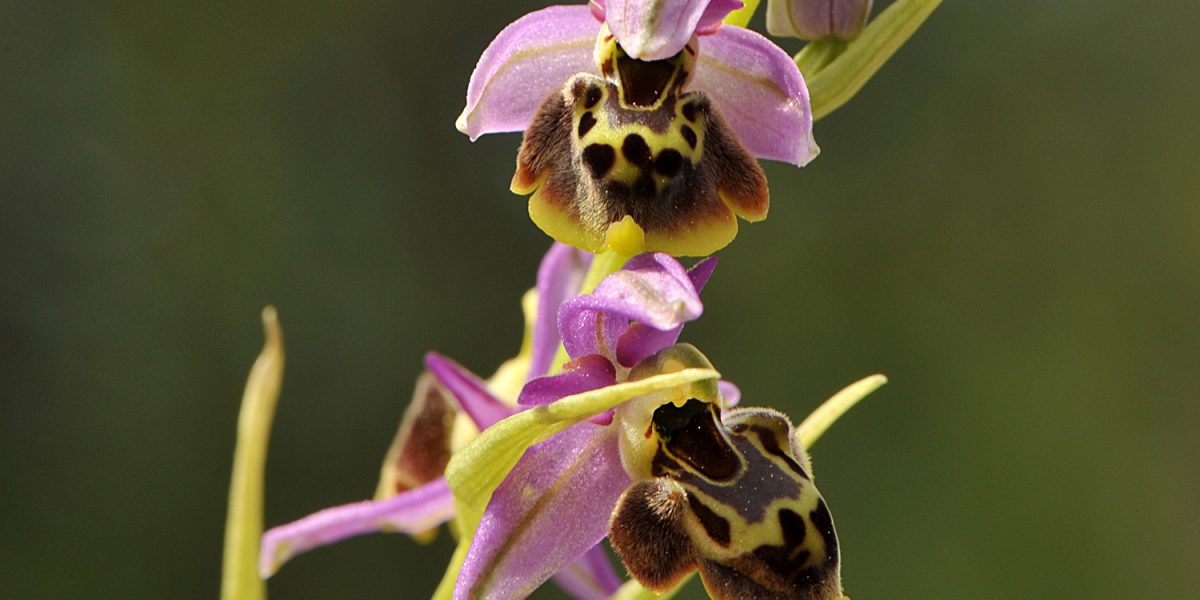
This year, Evia is the target. There are several municipalities there that are going to secure their swimming waters with nets, which will keep out jelly fish like the the mauve stinger (Pelagia noctiluca) so that people can play in the water without worry. Hopefully, those nets are also resistant to predatory hareheads. Before you know it, hareheads will conspire with jellyfish to breach into restricted areas.
I have always felt safe in the sea on Lesvos. I might even have seen more dolphins than jellyfish. Floating through the blue water, the softness that caresses your skin, feeling weightless and rolling like a dolphin in the waves. No matter how much I used to love swimming, nowadays I feel a strong protest in my chest when I go into the water. As if all those cancer cells resembling sea creatures are afraid of being dumped into the vast ocean. If only that could be possible…