




I wonder if Aesop, the Greek poet who lived around the sixth century BC also had ants in his house. He enriched the world with entertaining animal stories, which later formed the basis for the famous fables of La Fontaine. One of them is about a cricket and an ant.
The ant worked tirelessly in the summer to have enough food stored for the winter. While the cricket added even more luster to the warm months with his songs. What proved fatal for him during the winter, when hunger gnawed at his stomach so much that he had to knock on the ant’s door for help. But the hard-hearted ant reproached the cricket for being a good-for-nothing during the summer. He could now go dance to chase away the cold and slammed the door in the hungry cricket’s face.
The moral is that the cricket, with foresight, should have better prepared for the winter. But the cricket, which symbolizes the arts, had the task of lightening the summer.
There are about sixty species of ants on Lesvos. These little pests sometimes make your life impossible in the summer because they swarm into your house and carry off everything that fits in their winter storage. Gluttonous animals – irritating even, though they will certainly contribute their part to nature.
Cancer has taken possession of my body, and just as ants can bring down entire structures, the tumors are doing the same to my body. They drain my life force and leave me bedridden, giving me more and more time to study the ants.
But that’s not entirely true. While black ordinary ants are very visible outside waiting on the clothesline to appropriate the laundry, or sometimes running in circles around the bathtub, this summer there is a new colony inside the house. Approximately 6 mm large ants, black with a red head, they swarm, mainly through the kitchen. According to an internet search, they are Crematogaster scutellaris (their Dutch name translated to English: Red Scorpion Ants). That name alone drives me up the wall, as the house occasionally juggles with other pests like millipedes, camel spiders, and sometimes a scorpion. The main target of the scorpion ants was the jar of honey, which is now safely resting in a basin of water. No idea what those creepy creatures are up to now. The problem is that when they see you coming, they make a quick escape, like a seasoned scorpion. So studying these little monsters from the sickbed is out of the question, especially now that the honey candies are locked up and you only catch a glimpse of them every now and then.
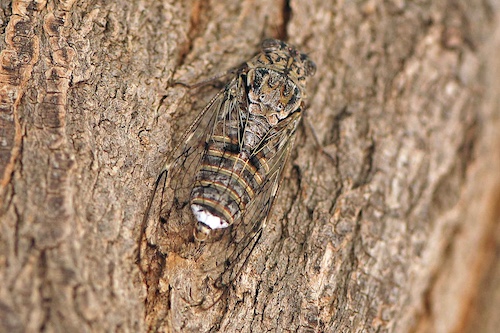
Tired of their endless game of hide and seek, I close my eyes and am treated to the cheerful concert of the crickets. You don’t see crickets dart away like scorpions; they remain masters at hiding among the greenery of the trees. It is very easy to exterminate ants, but giving a cricket a smack for being too loud is an almost impossible task due to their invisibility. However, crickets rarely give rise to complaints. Only when the heat hits and their loud screaming can sometimes be considered a nuisance.
No idea how many species of crickets are found on Lesvos. But it does have its own cricket: The Lesvos Bush Cricket (Poecilimon mytelensis). Good luck to see that cricket. An impossible task, at least from my bed. If their songs could now be distinguished by type, I would have had a chance. But no, crickets make quite monotonous music. I wouldn’t even know how many crickets participate in one piece of music. But despite their somewhat monotonous program, cricket concerts remain for me the voice of summer in the south of Europe. And even now that I have enjoyed so many summers on Lesvos, their monotonous singing remains a balm for the soul.
Now I am floored by cancer and have all the time to quietly listen to the crickets, truly much more pleasant creatures than those voracious ants. They are musicians who are needed to make life more pleasant. And so my island life slips into an ever smaller world.