
I wouldn’t say I’m a Dutch cheese girl, but I do come from a country of delicious cheeses. And I love French cheeses. That is why it took some time getting used to the cheeses the Greeks put on the table on Lesvos: firm farmhouse cheeses.
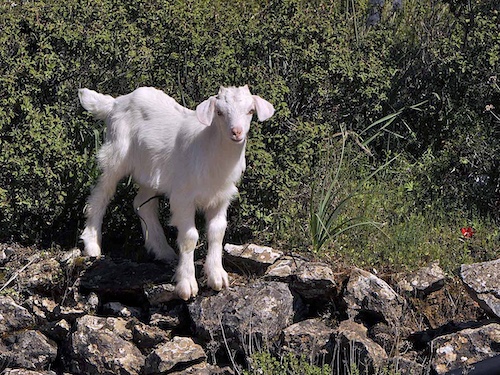
There is more than just feta on Lesvos. The island is famous for many more cheeses, made with a mix of sheep and goat milk, both soft and hard: kaseri, ladotiri, myzithra, gravièra and kefalotiri. In Agiasos, touloumotiri can sometimes still be found, this traditionally ripens in sheep or goat skin, just as it did when first made some 4,000 years ago.
The history of Greek cheese began with feta. As early as 800 BC, Homer revealed how to make cheese in his magical tale of Odysseus. The Greek hero and his men were trapped in a cave by the one-eyed cyclops Polyphimos, who kept sheep and made cheese, that Homer describes in detail. Before Polyphimos could devour everyone, Odysseus managed to blind the giant, allowing the surviving party to escape the cave by hanging from the undersides of sheep’s bellies.
Nowadays, cheese is produced on a large scale in factories that no longer use animal skins (with the exception of the touloumotiri). But who knows how people still fabricate their own cheeses at home. Lesvos has a number of large cheese factories, such as in Chidera and Mesotopo. The oldest factory is managed by the Agricultural Cooperation of Mandamados, which began with olive oil in 1929 and, in 1959, it encouraged local farmers to contribute their milk to collectively produce cheese. Mandamados, famous for its Taxiarchis monastery, has sub-municipalities that include the villages of Kapi, Pelopi and Klio. It is the area where most of the island’s livestock roam the mountain slopes.
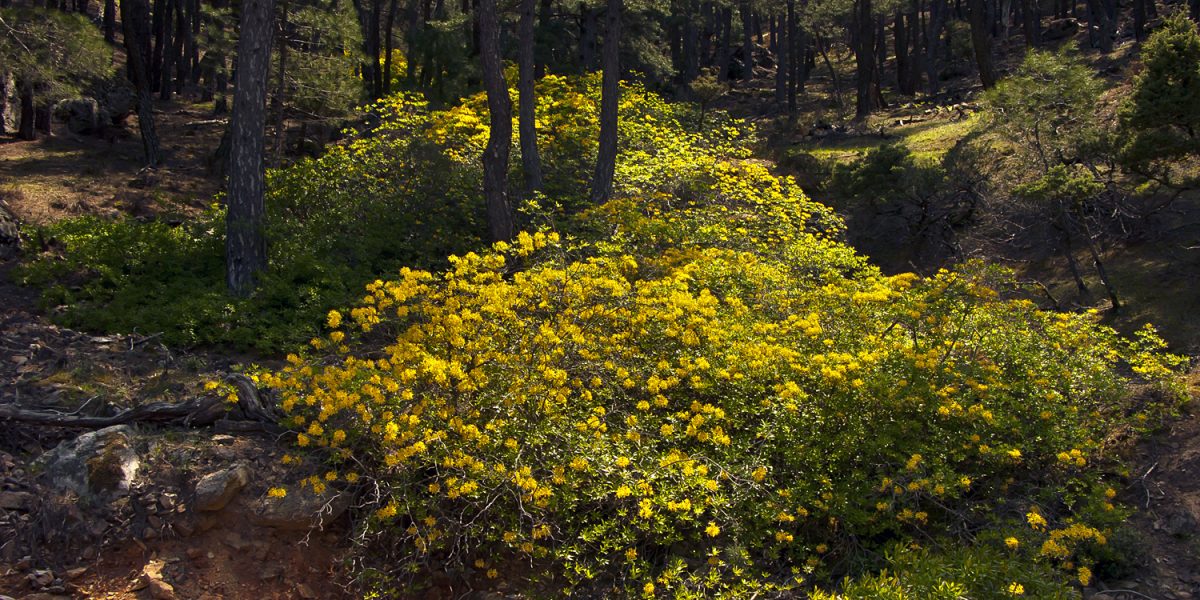
Last year, the island’s approximately 420,000 sheep and goats produced about 52,000 tons of milk: enough to make quite a lot of cheese. This spring is bursting with lush grasses and colorful flowers. For the grazing animals, this is like dining in a five-star restaurant, ensuring their milk is full of the island’s flavours, and a wonderful aroma is naturally imparted to the cheese. An excellent cheese year.
However, a few weeks ago disaster struck when several animals in Pelopi were discovered with foot-and-mouth disease. This is a highly contagious viral disease affecting all cloven-hoofed animals such as sheep, goats, cows, pigs and deer. Humans have nothing to fear from it. The number of infected animals is slowly rising, as is the number of animals that need to be culled. As a result, many farmers are suddenly left without their livestock and will soon start twiddling their thumbs behind the geraniums.
Factories and slaughterhouses have been shut down and not a single dairy product is allowed to leave the island, let alone a sheep or a goat. And this, in the days before Greek Easter on April 12, when 70,000 young sheep were on the list to be turned into a Passover lamb, a quarter of which would even have become a Passover lamb abroad.
The lamb eating feast is surrounded by numerous special days, but even after Easter, there are still many holidays throughout the year related to the Passion of Jesus. Two weeks after Easter Sunday is the Day of the Women, who brought myrrh and other herbs to the tomb of Jesus to anoint his body. Besides the names day of Archangel Michael on November 8, this is the second major feast day at the Taxiarchis Monastery in Mandamados, to which thousands of pilgrims will flock. It is still believed that Saint Michael of Mandamados performs miracles. He once defeated a ship full of pirates to save the sole surviving monk from a massacre at the monastery. When the Turks invaded Cyprus in 1974, many Greek soldiers were certain they saw Michael fighting alongside them, while a life-sized mural painting of the Archangel Michael in Mandamados remained empty for a week.
The occurrence of foot-and-mouth disease is like a blow from the sword of Archangel Michael and will reverberate through the economy of Lesvos for a long time; far from everything here revolves around tourism, which is precisely the charm of the island. But this year, Greek Easter will be a somber occasion in and around Mandamados. The region certainly needs a miracle.