
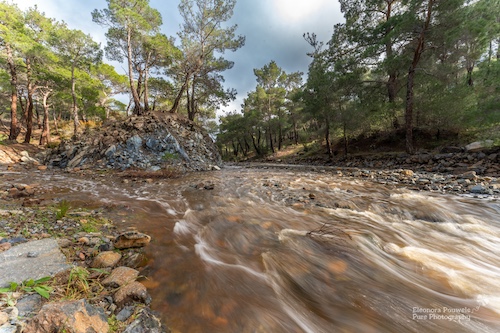
(Diavolorevma, photo: Eleonara Pouwels)
It’s raining and it’s raining. Summer tourists will never believe that the island’s usually bone-dry riverbeds have now swollen with water in record time and are behaving like real rivers with flowing water. And with all the tricks of real rivers. The sometimes wild waters tear away pieces of the river banks, carrying away uprooted trees, with great fanfare, out to sea. Or sometimes there is a great awakening. When a heavy downpour finally broke loose in mid-November, after the long and dry summer, the riverbed of the Tsiknias river and those of many other waterways were so startled that they allowed their waters to overflow onto the land, resulting in entire parts of Kalloni and Skala Kalloni being flooded.
It’s raining and it’s raining, that’s what the weather gods have decided for this winter. You get the feeling that water is constantly pouring from the clouds and that the sun has gone on a long vacation to Farawayistan. Whilst I was in the Netherlands, there were rather more tears than rain that fell because of the research into that cursed cancer. Nevertheless, between tears, I was able to enjoy snow and I even heard the scraping of ice skates on the ice. All very nostalgic, which is logical when you’ve reached this stage of your life. But I have also been looking ahead, and I long for the spring, that always starts too early on Lesvos with it’s anemones and almond blossom. So it was a bit of a shock when, after about two months away, I returned to a flooded island.
It’s raining and it’s raining and the rivers are flowing abundantly. Not only the large rivers like the bird-rich Tsiknias that flows into the Gulf near Skala Kalloni, but also the Evergetoulas, rich in exotic plane trees, which meanders through the heart of Lesvos straight into the Gulf of Geras, and the Tapsas River with its beautiful reed banks that flows into the sea near Faneromeni (Sigri), or the Sedoundas River with its whimsical banks, that patiently descends from the mountains toward Plomari. These are only a few of them; but in winter, numerous smaller rivers spring into action on the island, some flowing boldly across roads and others appearing in places where you’ve never seen a drop of water before.
It’s raining and it’s raining and the waterfalls are celebrating. Even in the summer, some waterfalls can enchant you with their cascading water, such as the Vathilimno near Pterounda, which was immensely popular last year amongst tourists. Now after all that rainfall, when walking in the mountains you cannot miss the sound of waterfalls which seem to be everywhere, offering endless opportunities for breathtaking pictures.
It’s raining and it’s raining and life goes on. In villages, ancient walls are collapsing, fields and roads are flooded, boulders are sliding onto the road. Even the Kremasti Bridge whose round arch for over four centuries has spanned the Kakara, a tributary of the Tsiknias River, was unable to withstand a small flood and was damaged in November. The road in Eftalou, which had already partially collapsed two years ago, now has disappeared further into the sea. But Kalloni has learned its lesson and is bravely holding its ground against the water, even though roads and fields are occasionally still being flooded. Not everyone can withstand the large amounts of water the rain gods are dumping on the island this winter.
It’s raining and it’s raining, and I’m also bravely holding steadily against the flood of cancer cells, which have been temporarily contained with some radiation. Most places on the island have regained their natural drainage system after so many years of Saharan-like winters. Although even in the past, it sometimes happened that an excess of water couldn’t be contained. Anything is possible. Also in my body. No idea when a new offensive will be launched against my lungs. But for now, I can still enjoy this wonderfully green and soaking wet island where countless rivers flow in imitation of Venice with all its waterways. Winter rivers, let’s call them that. So exciting!