
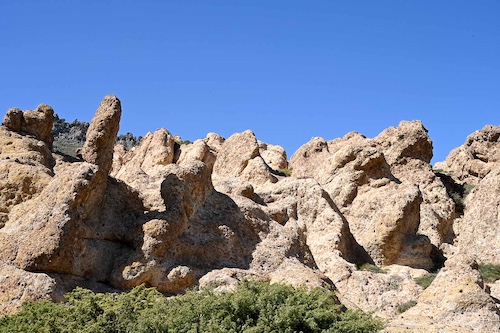
(A tuf landscape near Chidera)
I am not a volcano.
While November was the wettest month in a long time on Lesvos, and mushrooms in the forests are fighting for room to see the daylight, I’m stuck with those amoeba-like cancer cells making my lungs unsafe. We had few to no mushrooms for years due to dry autumns, but now there are so many that professional pickers are complaining about plummeting prices. It’s a pity mushrooms do not fight cancer cells.
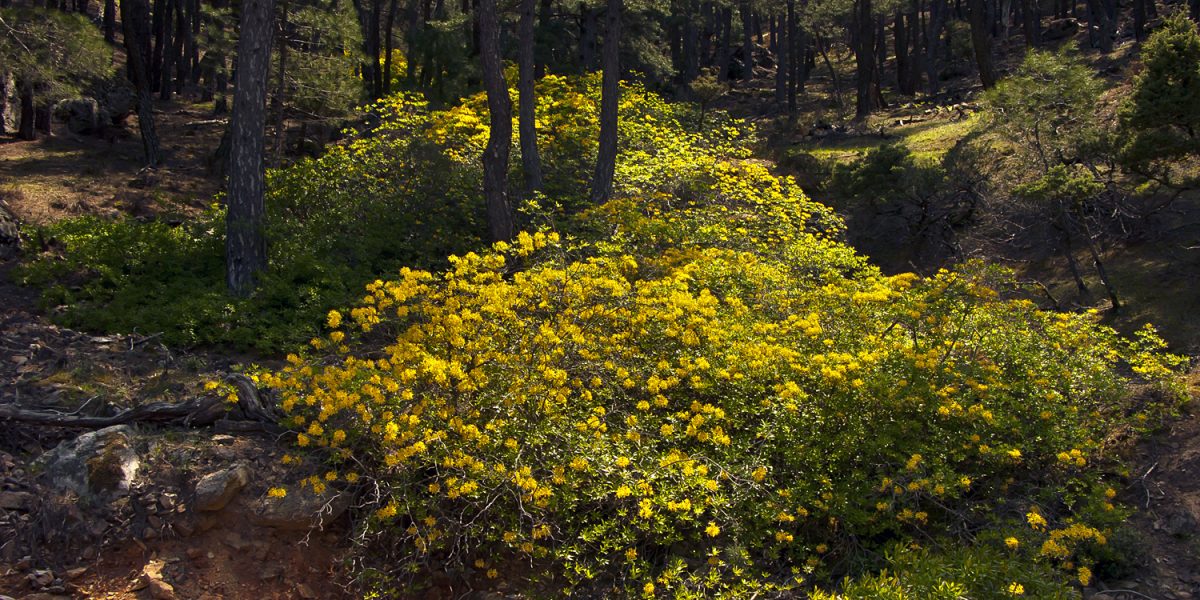
I’m in the autumn of my life. Given my age, but now also with my health. Autumn is also reigning over Lesvos, but that’s just a recurring season, whereas I probably do not see another autumn again. There must be a difference. Autumn on Lesvos: a wonderful time when, after the dry summer, entirely new worlds suddenly burst from the earth: mushrooms, grasses, wild vegetables, and other plants that paint the landscape bright green again.
I have no idea what color cancer cells have. I don’t want to know either. I don’t like having everything explained to me exactly with pictures, photos, and diagrams. I’d rather let my imagination run wild with how those evil little devils conquer my body. I find that less threatening.
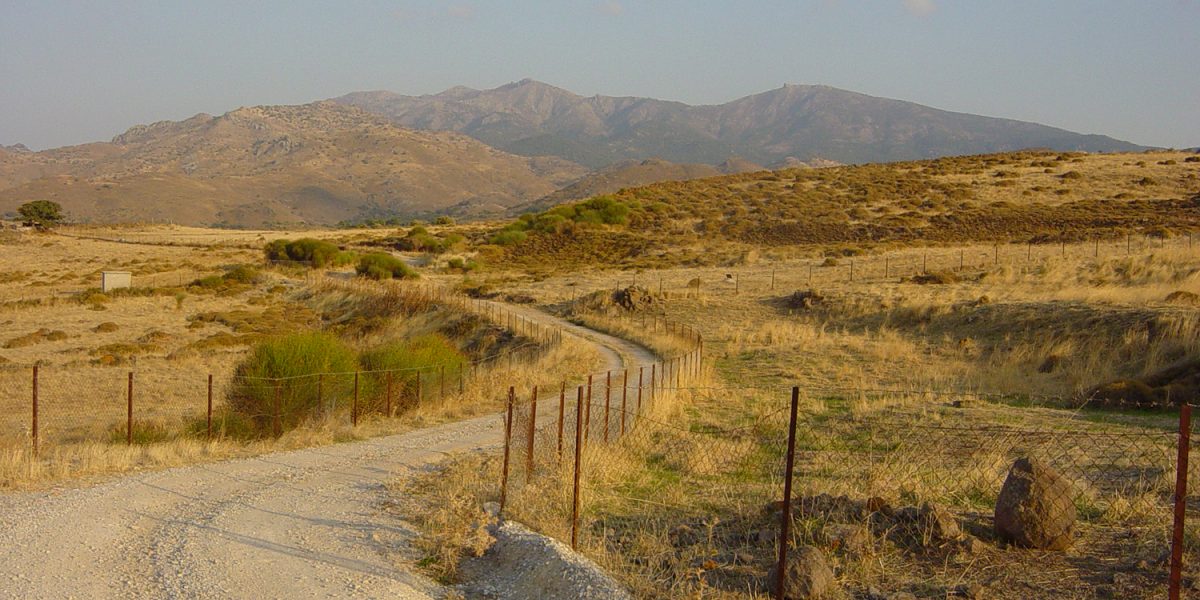
A few months ago, I was surprised by a bizarre landscape near Chidera, where jagged shapes rolled down the mountain: tuff. Tuff is a composure of volcanic ash and other rocks. Due to erosion, it has taken on the most bizarre shapes. I’ve never been to the moon, and given my condition, I probably never will, but that little piece of tuff landscape near Chidera could be a moonlandscape.
As if I had a premonition of what research would later reveal within me, I associated the meandering shapes with the inside of my lungs: a lung landscape. That is now being attacked by drones that are shooting down cancer cells, to say it in a modern way.
Lesvos is one big volcanic amusement park. Throughout the island, you’ll find extraordinary stone and rock formations, all created when the volcanoes terrorized the island. Some mountains appear to be built with upright columns, such as the lava columns near Ligonas and Pelopi, while square stones adorn a mountain near Eresos. There are rock formations with undulating layers in Faneromeni. The little mermaid church (Panagia tis Gorgonas) in Skala Sykamnias is built on red lava rocks. Often, people don’t even realize they are standing on an extinct or failed volcano: the Panagia Glikofilousa church in Petra is built on a so-called volcanic plug, while the Ypsilo Monastery with its impressive collection of lightning rods is built on a volcano that never awakened: a lava dome.
Maybe the doctors find the landscape of my lungs very interesting now too. I have one test after another, and I am now in stade 3. I chose not to start a chemo, risking more damage than a cure. On Lesvos, the greatest scientific attention is focused on the petrified trees, which is probably the most captivating for visitors. Millions of years old trees are being found at the site where they were once surprised by fire-breathing mountains, sometimes still with branches and leaves attached. Beneath layers of earth in western Lesvos, entire ancient forests are still buried. No idea if the cancer cells are burying the walls of my lungs too.
More than once I am amazed by all the fascinating landscapes the island has to offer. Some with a mysterious touch, like the Rock of Issa, others nearly unnoticed, like the lava ridge near Avlaki (near Petra). An island full of volcanic remnants. My lungs are nothing compared to that. I am just one of the volatile passersby’s who are allowed to dance for a moment on volcanic Lesvos. Luckily, cancer cells can’t destroy entire islands. Even though it decimates a significant part of the world’s population. I’m not alone.